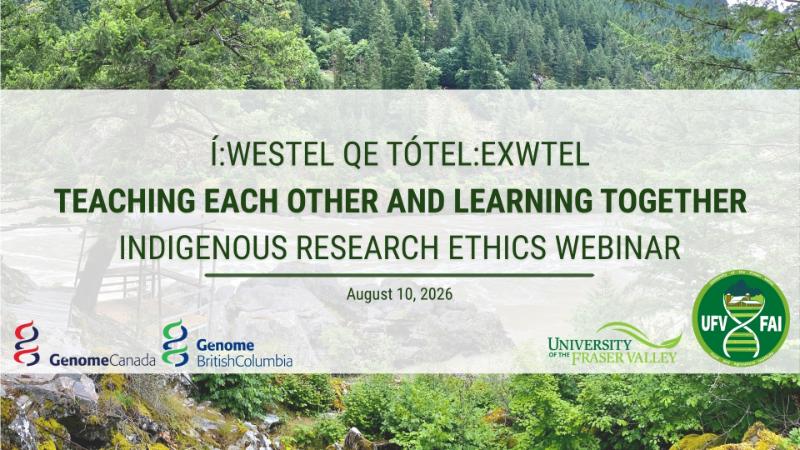
Genome BC hosted an ‘Indigenous Research Ethics Webinar’ featuring a presentation on the The Í:westel qe tótel:exwtel (Teaching Each Other and Learning Together) Toolkit, developed in partnership with the Stó:lō Community Advisory Committee. The webinar and toolkit provide a practical framework for embedding Indigenous data sovereignty and ethical engagement into the foundational stages of research. The webinar served as a platform for knowledge sharing on:
- Ethical Frameworks: Integrating UNDRIP, OCAP®, and CARE principles to ensure research respects Indigenous rights and sovereignty.
- Community-Academic Partnerships: Highlighting successful models of collaboration and practical tools for allyship.
- Practical Implementation: Navigating the challenges of community-driven research to foster respectful, transparent, and mutually beneficial relationships.
The Climate Change Scenarios and Agricultural Sustainability Tool
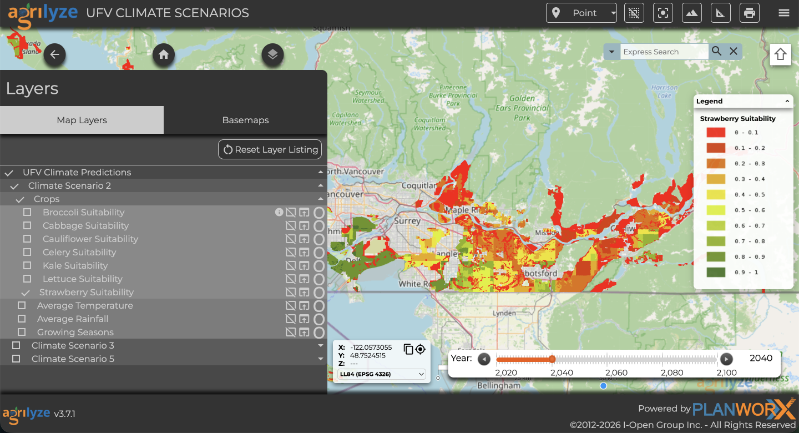
Interactive map displaying the outcomes of a research effort that modelled future agricultural suitability under different climate change scenarios. The model outcomes are displayed using the Agrilyze map-based platform. When first accessing the map, click the data layers icon above the left panel to get started, and then expand the UFV Climate Predictions category to explore the data. Select and expand a climate scenario category to see the model outcomes for a particular climate future, and the expand the Crops category to find and display the data layers for future agricultural suitability for different crops. Use the time slider at the bottom of the screen to see the data for a particular year between 2020 to 2100), and expand the Legend on the right side of the screen to see the agricultural suitability values, from 0 (not suitable) to 1 (most suitable). More information on the research project can be found in this report.
This tool was developed by researchers from the Transdisciplinary Research on Integrated Approaches to Sustainability (TRIAS) lab, led by the Canada Research Chair in Climate Change, Biodiversity, and Sustainability at Royal Roads University. TRIAS also serves as the co-project lead for The Social Implications of Agri-Genomics project.
Agri-Tech Adoption Simulator
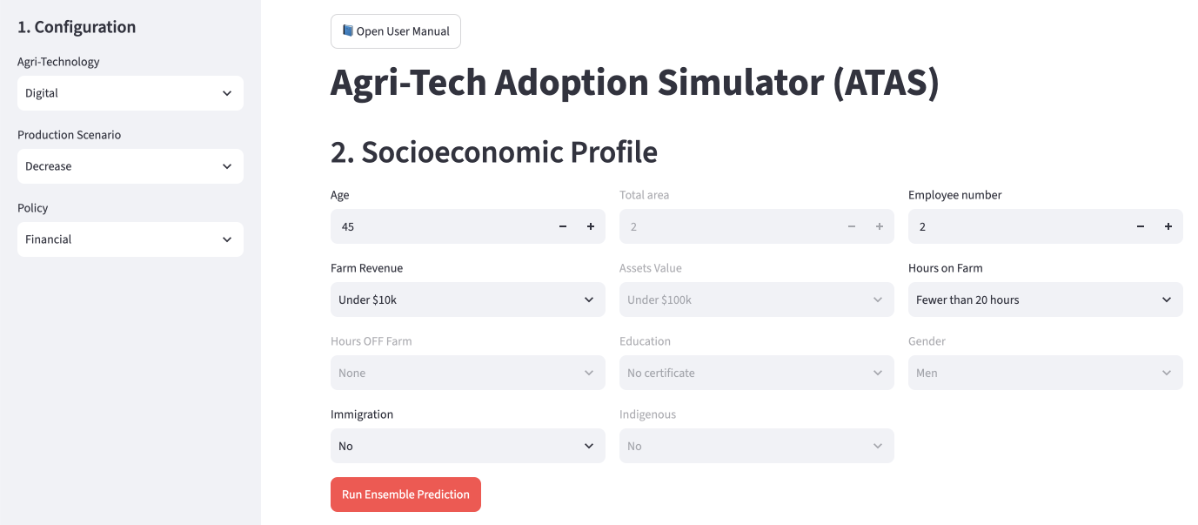
The Agri-Tech Adoption Simulator (ATAS) is a tool designed to help researchers and policymakers understand how different policy interventions and farmer/farm characteristics influence the probability of adopting agricultural technologies (i.e., agri-tech). ATAS specifically focuses on technologies in the areas of digital agriculture, controlled environment agriculture, and agri-genomic technologies. ATAS simulates the likelihood of agri-tech adoption based on the type of agri-tech to be adopted, whether climate and geopolitical conditions will result in increased or decreased production, the types of policies that are in place to incentivize adoption, and the socioeconomic characteristics of the local farmer population.
DOWNLOAD SIMULATOR USER GUIDE
This tool was developed by researchers from the Transdisciplinary Research on Integrated Approaches to Sustainability (TRIAS) lab, led by the Canada Research Chair in Climate Change, Biodiversity, and Sustainability at Royal Roads University. TRIAS also serves as the co-project lead for The Social Implications of Agri-Genomics project.
The Agri-tech Park Visualization
Interactive visualization tool of a hypothetical agri-tech park located in Langford, British Columbia, Canada. This tool was developed by researchers from the Transdisciplinary Research on Integrated Approaches to Sustainability (TRIAS) lab, led by the Canada Research Chair in Climate Change, Biodiversity, and Sustainability at Royal Roads University. TRIAS also serves as the co-project lead for The Social Implications of Agri-Genomics project.
This tool will be presented on web-based and virtual reality platforms and presents different scenarios for creating urban agriculture agri-tech parks, providing opportunities for participants of this tool to explore how different agri-technology facilities, such as vertical farming and cellular agriculture could be designed in their communities and neighbourhoods.
 Visualization of Diverse Food Assets in an Agri-Tech Park
Land, Food, and Work in Conversations with Cellular Agriculture
Project team members of the Social Implications of Agri-Genomics research team attended the Cultivating Resilience Summit: Advancing Climate-Smart Agri-Food in Vancouver, BC, presented by AG-ACt, BCCAI, BC ACARN & SFU Public Square. Four team members, pictured below, submitted a poster presentation on their research that approaches the development of the agri-genomic technology industry from the framework of a Just Transition to ask: How will these emerging agri-production systems engage with existing agricultural labour regimes? In this poster, these four researchers focused on three prominent themes emerging from conversations relating to Land, Food, and Work in Conversations with Cellular Agriculture.
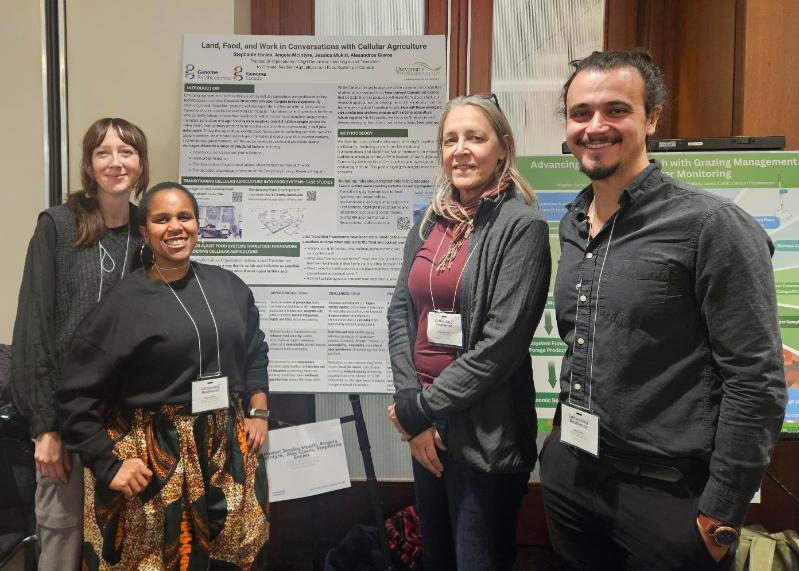 Research team members Stephanie Eccles, Jessica Mukiri, Angela McIntyre, and Alesandros Glaros (pictured left to right), with a poster presentation of their collective research. Cultivated Resilience Summit, October 2025