  • Future Students
  • International
  • Current Students
  • Alumni
  • Donors
  • Calendar
  • myUFV
  • myClass
  • Library
  • Careers
University of the Fraser Valley
UFV.ca
  • Information For
    •   Alumni
    •   Current Students
    •   Donors
    •   Future Students
    •   International
  • Tools
    •   Academic Calendar
    •   Library
    •   myUFV
    •   myClass
  • Programs
  • Admissions
  • Student Services
  • Research
  • News
  • Events
  • About UFV
A teacher candidate in a row of young students, all holding hands and wearing pink shirts.

School of Education

UFV/School of Education/About the School of Education
  • Find your program
  • Ask a question
  • See an academic advisor
  • How to apply
  • Prerequisite waivers

About the School of Education

Our mission and vision

As a community of learners, the UFV School of Education (SOE) strives to wholistically facilitate the growth of critically minded, creative, compassionate, and responsive educators who are committed to fostering equitable, inclusive, and decolonizing learning environments.
Because we want to make the world a more equitable and kinder place, we strive to imagine and advocate for a future where people think carefully and care-fully before they speak or act; and where they make wholistic and ethical decisions that consider impact for all beings. We seek to actively disrupt and resist the genocidal forces of colonial narratives, policies, and practices.
Through individually and collaboratively modeling innovative and engaging teaching practices that embed the SOE Commitments and Values into the work (with students, with colleagues, with community, with the world), we facilitate the creation of a community where all learners can flourish.


School of Education values
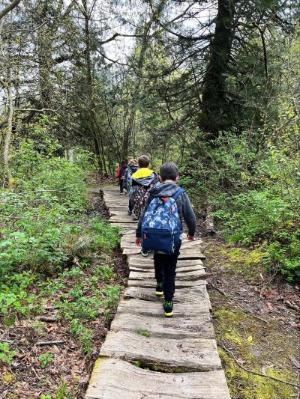
Children walk along a wooden walkway through the forestThe School of Education is informed by five values.

Pedagogical sensitivity

The SOE supports a learner centered view of teaching. Educators must understand the importance of the learner-teacher relationship and its ethical underpinning, while honouring and respecting the needs of each learner. Educators must have the knowledge, skills, and confidence to adapt and develop curriculum to meet the specific needs of each learner. 

Reflective practice

The SOE believes that educators must engage in reflective practice. Reflective practice is the ability to reflect in a thoughtful and comprehensive way on the significance of different teaching and learning situations and on the educator’s role in creating and maintaining a healthy learning environment for everyone. Educators must demonstrate self- knowledge by openly identifying personal biases and projections. Reflective practice, guided by the principles of self-evaluation and inquiry, is considered the foundation of continuous professional growth.

Critical mindedness

The SOE believes that educators must understand the complexity, subtlety, and difficulty of contemporary educational questions and issues. This understanding is extended to their colleagues – as educators value the experiences of their peers, recognize the diversity that is possible within instructional techniques, and choose to learn all that they can without passing judgment on fellow professionals. In an attempt to solve problems, educators must show a high degree of flexibility in comparing various perspectives, seeking alternative solutions, and engaging in collaboration. 

Social justice

The SOE believes that educators must be committed to honoring and nurturing the diverse experiences and identities of marginalized and all people. This commitment requires a critical awareness of one’s own positionality and the ability to see beyond personal worldviews. Educators are called to actively examine and challenge their personal biases, work to dismantle systemic inequities, and advocate for the rights and dignity of both learners and the broader community. Equally important in their role is empowering learners to become advocates for themselves and others, fostering more authentic, ethical, and responsible engagement with the world. The SOE places a high value on the moral and ethical responsibilities of educators, recognizing them as essential to transformative teaching and learning. 

Integration of knowledge and practice

The SOE supports the seamless connection between knowledge (academic disciplines), educational theory, and practice (methods for achieving educational ends). Educators must constantly engage in the recursive interplay of knowledge, educational theory, and practice throughout their professional lives. 


Commitment: decolonization & Indigenization
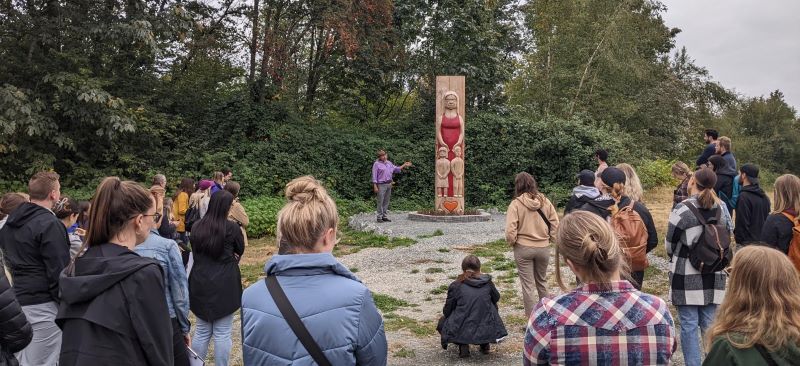
People gather around an Indigenous teacher who's pointing to a totem pole

The School of Education has made a strong commitment to decolonizing practices, and Indigenizing curriculum and pedagogy. We warmly welcome Indigenous learners into SOE programming and actively seek to incorporate Indigenous Ways of Knowing and perspectives into our curriculum.

Terrible things have been done in the name of education in Canada – not the least of which were the attempts by the Canadian government to assimilate thousands of Indigenous children into White Settler society through Indian Residential Schools (IRS). The primary goal of these schools was to “kill the Indian in the child”. Senator Murray Sinclair (the Chief Commissioner for the Truth and Reconciliation Report), when speaking about the harm perpetrated in the name of education in these schools, stated, “Education is what got us into this mess; and education is what will get us out.”

Armed with the new understandings we have come to because of the stories of truth shared by IRS Survivors through the Truth and Reconciliation Commission Report, SOE programming at UFV seeks to mitigate some of this damage and work to create a society where Indigenous children and adolescents are valued for who they are.

Social justice & anti-racism
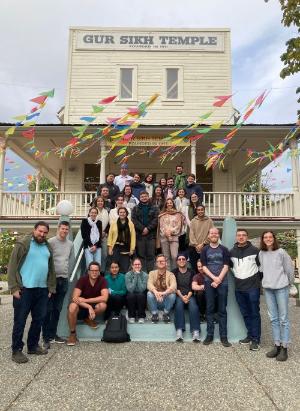
A group of UFV students in front of a Sikh temple

Social Justice, as one of the five School Values, is a tenet that all faculty, staff, students, and teacher candidates are expected to uphold. This value will be demonstrated through the ways in which we work together, and the ways in which we work with children and adolescents. We will create inclusive learning environments that are ethical and safe by using individualized and equitable approaches that engage learners and include their voices, and by exposing gaps in schooling and curriculum that serve to minimize or marginalize children, students, and teachers.

However, social justice also requires us to become knowledgeable about racism and discrimination, thus spurring us to challenge status quo, power, and privilege within education and schooling. We all hold prejudice and discriminate against others – this is built into the way that we are hardwired as human beings. Our job as educators is to acknowledge and push against this within all aspects of our daily lives – to become antiracist educators. This means interrogating ourselves, our experiences, and our practices; and wrestling with the discomfort that will emerge. It also means engaging in critical discourse, acknowledging and examining our own biases, and having courageous conversations about injustice and our own experiences with it.

 

  • Find your program
  • Ask a question
  • See an academic advisor
  • How to apply
  • Prerequisite waivers
  • About the School of Education
  • Find your program
    • Early Childhood Education — certificate
    • Education — bachelor's degree
      • Teaching French as a second language
    • Master of Education — Educational Leadership and Mentorship
    • Inclusive Education Assistant — certificate
  • Prospective student info
    • Attend a program info session
    • Program FAQ
      • Bachelor of Education FAQ
      • MEd FAQ
      • ECE FAQ
      • IEA FAQ
    • Bachelor of Education
      • How to become a K-12 teacher
      • BEd admissions checklist (elementary/middle school option)
      • BEd admissions checklist (secondary school option)
      • Upcoming courses
      • Course equivalencies for BEd admission
      • Certified teachers from other countries
      • Tips to prepare for UFV’s teacher education program
      • Internationally educated applicants (no teaching credential)
    • Early Childhood Education
      • Admissions Checklist
      • Becoming an early childhood educator in BC
      • Tips to prepare for UFV's ECE program
      • Upcoming courses
      • Certified ECEs from other countries
    • Master of Education
      • Advancing your career as an educator with an MEd
    • How to apply
    • Prerequisite waivers
    • Inclusive Education Assistant
      • Admissions checklist
      • Tips to prepare for UFV's IEA program
      • Upcoming courses
  • Current student resources
    • BEd resources
      • BEd mission and goals
      • BEd student handbook
      • Graduation and certification
    • MEd resources
      • Graduation
    • ECE resources
      • Upcoming courses
      • Program & prerequisite waiver
      • ECE mission statement
      • ECE student handbook
      • ECE dual credit
      • Graduation and certification
    • Meet with an advisor
    • IEA Resources
      • Program & prerequisite waiver
      • Graduation
      • Upcoming courses
      • IEA dual credit
      • IEA Completion Planning
  • Scholarships & awards
  • Faculty & staff
  • SOGI in schools
    • Video interviews
    • Resources for teachers
    • Resources for families
  • Contact us
    • Mentor a teacher candidate

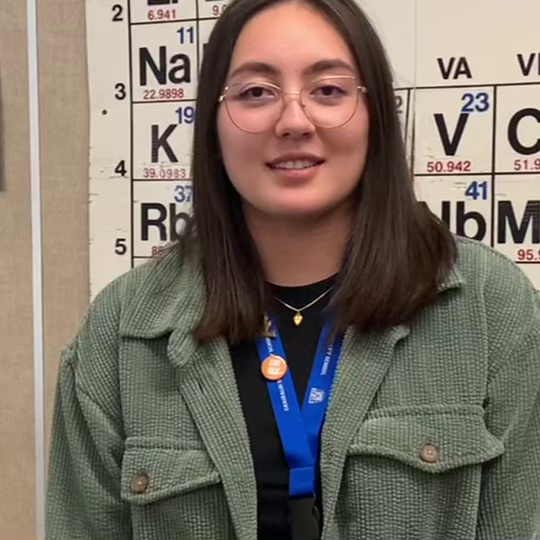
Yuri, Teacher candidate

"I had very engaging and passionate science teachers that made me passionate and interested in the topics."

Yuri & Suman share why they're pursuing careers in education, what they love about teaching, and offer advice for anyone who's interested in becoming a teacher.

Watch video

SOGI in Schools web resource

The School of Education partnered with local educators to create a new web resources to support teachers, inform families, and reduce misinformation.


SOGI in Schools


  • 604-851-6342
  • soeinfo@ufv.ca

Future students

Academic Calendar
Find your program
How to Apply
Book a tour
Transfer credits
Tuition & fees
FAQs

Help

Ask a question
A to Z websites
Directory
Emergency contacts 
IT Service Desk
Reset your password
Safety & Security
myUFV

Current Students

Academic Advising Centre
Bookstore
Register for courses
Safe Student Community
Shuttle bus
Student services
Timetables
myClass
CIVL Radio

About us

Accessible UFV
EDI & Human Rights Office
Accreditation
Careers at UFV
Cascades Athletics
Make a gift
Events
Human Resources
News
UFV 50
Contact us

University of the Fraser Valley (UFV)

University of the Fraser Valley

33844 King Road, Abbotsford, BC

Canada V2S 7M8

604-504-7441

The University of the Fraser Valley is situated in the traditional territory of the Stó:lō peoples. The Stó:lō have an intrinsic relationship with what they refer to as S'olh Temexw (Our Sacred Land); therefore, we express our gratitude and respect for the honour of living and working in this territory.

Copyright · Privacy · Sitemap · Feedback

  • \

Contact Us

  •   1-604-504-7441
  •   1-888-504-7441 Toll-Free
  •   Maps
  •   Ask a question